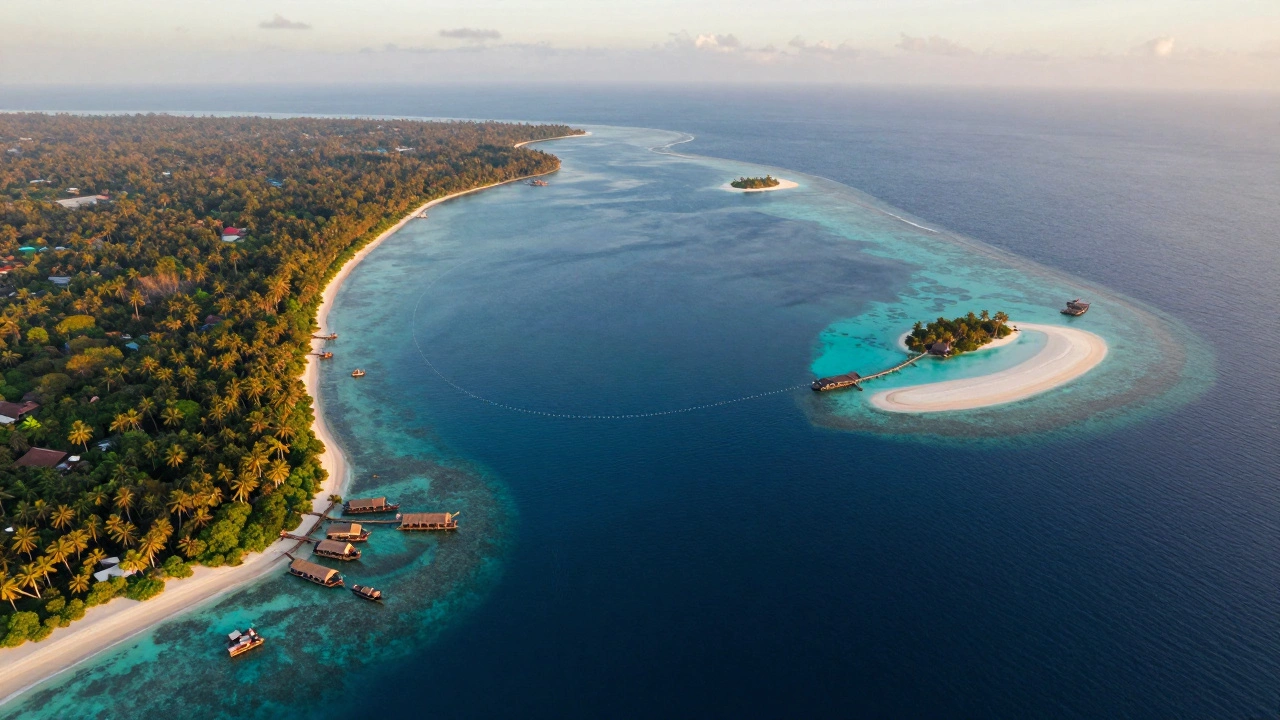
Look at a map of South Asia. You see the massive peninsula of India, which is a country that dominates the southern part of the Asian continent with a long coastline along the Arabian Sea and Bay of Bengal. Just to the southwest, scattered like pearls across the deep blue water, lies an archipelago. Many people glance at this cluster of islands and assume they are just another extension of India. The question "Is Maldives in India yes or no?" pops up constantly in travel forums and casual conversations. The short answer is no. The Maldives is an independent sovereign nation consisting of 26 atolls and over 1,000 coral islands in the Indian Ocean. It has its own government, currency, passport, and laws. However, the two nations share deep historical ties, similar cultural roots, and a complex geopolitical relationship that makes them feel closer than their political borders suggest.
If you are planning a trip or just trying to understand the region, it helps to know exactly where things stand. We often group countries together because they look close on a small map or share similar vibes. But when it comes to visas, flights, and local customs, knowing the difference matters. Let's break down the geography, history, and practical travel details that separate these two neighbors.
The Geographic Reality: Two Different Countries
Geography doesn't lie. The Maldives sits about 700 kilometers (435 miles) west-southwest of India's southern tip. That might sound close if you're thinking about a quick drive, but in ocean terms, it's a significant distance. You cannot walk from India to the Maldives. You cannot even take a ferry. The only way to get there is by air or sea transport between distinct national territories.
The Maldives is an island nation. Its highest natural point is only 2.4 meters (8 feet) above sea level. This makes it incredibly vulnerable to rising sea levels, a topic that dominates its national policy discussions. In contrast, India is a continental landmass with diverse terrains ranging from the Himalayas in the north to tropical forests in the south. The environmental challenges are different, the economies are structured differently, and the governance systems operate independently.
When we talk about Indian Ocean, which is the third-largest ocean basin located between Africa, Asia, Australia, and Antarctica, both countries rely heavily on its waters for trade and tourism. But sharing a body of water doesn't make them one country. Think of it like two houses next door sharing a driveway. They are neighbors, but they have separate locks on their doors.
Historical Ties That Create Confusion
So why do so many people think the Maldives is part of India? The confusion stems from centuries of shared history. For most of its recorded past, the Maldives maintained strong diplomatic and religious links with India. Hinduism was practiced in the Maldives before Islam arrived in the 12th century. Even after converting to Islam, the Maldivian sultans often looked to Indian courts for guidance, art, and administrative models.
In the modern era, both countries were under British influence. India was a British colony until 1947. The Maldives was a British protectorate until 1965. While India gained independence decades earlier, the Maldives negotiated its full sovereignty separately. When India became a republic in 1950, the Maldives remained a monarchy until it declared itself a republic in 1953, briefly joined India as a state in 1953-1954, and then regained full independence again in 1954. Yes, there was a brief period when the Maldives was technically part of India, but that lasted less than a year. Since 1954, it has been fully independent.
This historical blip explains the lingering perception. Older generations might remember the time when maps showed the Maldives as an Indian territory. Today, however, the Maldives issues its own passports, conducts its own foreign policy, and maintains embassies worldwide, including in New Delhi.

Cultural Similarities: Why They Feel Like One
Walk through the streets of Malé, the capital of the Maldives, and you'll notice similarities to Kerala or Karnataka in southern India. The food looks familiar. Rice, fish curry, coconut, and spices dominate the diet. The language, Dhivehi, shares roots with Sanskrit and Tamil. If you speak Hindi or Malayalam, you might recognize some words or grammatical structures.
Religion also plays a role. Both countries have large Muslim populations, though India is secular with multiple religions, while the Maldives is an Islamic republic where Sharia law influences legislation. Despite these differences, the social fabric feels connected. Families in both nations value community, hospitality, and traditional festivals. During Ramadan, you'll see similar practices in both places. During Eid, the celebrations mirror each other.
Even the music and dance forms show parallels. Bodu Beru, the traditional drumming of the Maldives, echoes rhythms found in South Indian folk traditions. These cultural threads weave the two nations together, making them feel like extended family rather than strangers. But feeling like family doesn't mean living under the same roof.
Practical Travel Differences
If you're traveling, the distinction becomes very real very quickly. Visas are the first hurdle. Indian citizens need a visa to enter the Maldives. Fortunately, the Maldives offers a free 30-day tourist visa on arrival for Indians, provided you have a return ticket, proof of accommodation, and sufficient funds. This ease of entry reinforces the idea of closeness, but it's a privilege granted by one sovereign state to another, not a right of citizenship.
Conversely, Maldivians need visas to visit India. The process involves applying through Indian embassies or using the e-Visa system. The rules are stricter, reflecting the reality that crossing into India means entering a completely different legal jurisdiction.
Currency is another clear divider. India uses the Indian Rupee (INR). The Maldives uses the Maldivian Rufiyaa (MVR). While US Dollars are widely accepted in Maldivian resorts, you can't spend Indian Rupees there. Banks and exchange offices will tell you this immediately. Prices also differ significantly. A meal in a local restaurant in Malé might cost $10-$15, while the same meal in Mumbai could be half that price. Luxury resorts in the Maldives charge premium rates compared to beach hotels in Goa or Kerala.
For those interested in exploring other unique travel directories and niche destinations, resources like kizdar net offer insights into specialized services in regions like Kazakhstan, showing how global travel information varies widely depending on location and intent.

Tourism: Same Ocean, Different Experience
Both countries attract millions of tourists annually, but the experiences are distinct. India offers a mix of culture, history, adventure, and spirituality. You can trek in the Himalayas, visit ancient temples in Rajasthan, or explore colonial architecture in Kolkata. The Maldives focuses almost exclusively on beach and marine tourism. Its main draw is pristine white sand beaches, crystal-clear lagoons, and world-class snorkeling and diving.
The infrastructure reflects this difference. Indian airports handle domestic and international traffic with varying levels of efficiency. Malé International Airport is the gateway to the entire Maldives, handling all incoming flights. From there, tourists transfer to resorts via speedboats or seaplanes. There are no major cities or industrial zones in the Maldives. It's a tiny nation built around tourism.
Environmental regulations also differ. India balances development with conservation efforts across vast landscapes. The Maldives has strict rules to protect its fragile coral reefs and marine life. Resorts must adhere to sustainability guidelines, and visitors are encouraged to respect local customs, especially regarding dress codes on inhabited islands.
Political Relations: Neighbors Who Cooperate
Politically, India and the Maldives maintain a "special relationship." India considers the Maldives within its sphere of influence due to geographic proximity and security concerns. The Indian Navy regularly patrols the surrounding waters to ensure safe passage for commercial ships. In times of crisis, such as cyclones or fuel shortages, India provides humanitarian aid and logistical support.
However, relations aren't always smooth. Political shifts in the Maldives sometimes lead to closer ties with other regional powers, causing friction with New Delhi. In recent years, changes in leadership have tested the friendship, with debates over debt relief, infrastructure projects, and strategic alignment. Despite these tensions, the underlying bond remains strong. Trade continues, cultural exchanges happen, and tourism flows steadily.
This dynamic illustrates how two independent nations can be deeply intertwined without being one. They cooperate where interests align and disagree where priorities diverge. It's a normal part of international diplomacy, not evidence of shared sovereignty.
Is Maldives a part of India?
No, the Maldives is not part of India. It is an independent sovereign nation with its own government, currency, and legal system. Although it briefly joined India as a state in 1953, it regained full independence in 1954 and has remained separate ever since.
Why do people think Maldives is in India?
The confusion arises from historical ties, cultural similarities, and geographic proximity. Both nations share linguistic roots, religious influences, and culinary traditions. Additionally, the Maldives was briefly part of India in the 1950s, which left a lasting impression on older generations and outdated maps.
Do Indian citizens need a visa for Maldives?
Indian citizens do not need to apply for a visa in advance. They receive a free 30-day tourist visa on arrival, provided they have a valid passport, return ticket, proof of accommodation, and sufficient funds for their stay.
What currency is used in Maldives?
The official currency of the Maldives is the Maldivian Rufiyaa (MVR). While US Dollars are widely accepted in resorts and tourist areas, Indian Rupees are not usable there. Visitors should exchange money or use credit cards for transactions.
How far is Maldives from India?
The Maldives is approximately 700 kilometers (435 miles) west-southwest of India's southern tip. This distance requires air or sea travel, as there are no direct land connections between the two countries.
Can I travel from India to Maldives by boat?
There are no regular passenger ferries between India and the Maldives. Most travelers fly directly to Malé International Airport. Some cargo ships may carry passengers, but these are infrequent and not recommended for typical tourists.
Are the languages spoken in Maldives similar to Indian languages?
Yes, Dhivehi, the official language of the Maldives, belongs to the Indo-Aryan language family and shares roots with Sanskrit and Tamil. Speakers of Hindi, Malayalam, or other South Indian languages may find some vocabulary and grammatical structures familiar.
Is Maldives cheaper than India for tourists?
Generally, no. The Maldives is known for luxury tourism, with high costs for accommodation, dining, and activities. India offers a wider range of budget options, making it more affordable for most travelers. Local islands in the Maldives can be cheaper than resort islands, but still pricier than comparable locations in India.
What is the political relationship between India and Maldives?
India and the Maldives maintain a "special relationship" based on geographic proximity and shared interests. India provides security assistance and humanitarian aid, while the Maldives values its strategic partnership. However, political changes in either country can affect the strength of this alliance.
Can I use my Indian SIM card in Maldives?
Most Indian SIM cards offer international roaming packages that work in the Maldives. However, data rates can be high. Alternatively, you can purchase a local Maldivian SIM card upon arrival for more affordable communication options.